50 years since "The Fall Of Saigon"
- Fatdaygo

- May 12, 2025
- 12 min read
Updated: May 14, 2025
Fall: Abundance, The Harvest
I am nothing but happy to see the influx of general Vietnamese influence that is now highlighted in a positive light. All of Vietnam however, is very different, and almost completely segmented in taste and in sound. The same extensive and protracted shape of California, but just 80 percent of its space, yet it holds triple the state’s population. As you trace your finger on its map you’ll see that two rivers reach each end of its native land, allowing the perfect environment for rice to be cultivated at a mass rate, and in turn, anchoring two of its biggest cities at polar opposite ends of the country: Saigon, and Hanoi.
The north of Vietnam is heavily guided by Chinese significance. One can easily see it in the chopstick forward cuisine and their heavy use of beef, combined with their advanced technical skill in stir frying. The northern colder climate emphasizes heavier starches such as potatoes and stewed proteins for longevity and warmth, while the South has an emphasis on fresh herbs and sweeter notes from sugarcane opportunities. The Cambodian geographical relation to the South of Vietnam has also led to the use of things like egg noodles, palm sugar and coconut milk. Lingering are snails, baguettes, pate and a small but mighty brewing tool used to make coffee: the phin, evidence of the 19th century French colonization.
The wholesome relationship between product availability and constant neighboring country exchanges has created an extensive way to truly know regional Vietnamese cuisine. You’ll see now, why perhaps that stating a general, “I love Vietnamese food”, might seem dismissive to some, and our culture as a whole when you’re only regarding your local fusion place that offers lackluster chicken Banh Mis and powdered Thai Tea.
Is it dismissive though? Is it just with ignorance do we find disdain in how ingestible our food is? Or should we encourage the use of Vietnamese adjacent terminology being slowly introduced into your local midwestern mall? I think both perspectives can co exist so long as it remains something that is up for discussion: intake, output, result, and a yield.
I personally find it much healthier to see it as luck. Lucky are we to be welcomed into a culture after years of uncertainty of whether or not we fit into the future of the white picket fence. I think it is lucky that we can have a platform to argue whether what people say about our food is inappropriate, and not if we as a race are inappropriate at all. I’ll take whatever advantage we have, because I understand and remember the latter.
Do you remember the scrunched noses? Do you remember the fake gagging noises when people used to smell our spices? Our language? The same grace we’ve been given, are we giving it unto others? Now that we have the blueprint to make us acceptable, are we making sure we’re extending our arms to the less fortunate? The ones who don’t have jade bracelets or money trees? The non preferred, barely equal, and infamously “less fortunate”. What are you consciously and subconsciously putting out there? What makes us deserving to reap of this harvest?
Our families first came here to give themselves a chance, and in that chance, they had us. The generation that grew up on figuring out how to make sure we stayed invisible, scrubbing our skins white with papaya soap, and being hated by our Laos and Cambodian counterparts because their parents would tell them it was our fault they were here. Do people know how it felt to have parents feel like we owe them for being born? That while learning to navigate your mom or dad’s anger you also had to gentle parent them into learning how to file for taxes, translate car insurance policies, and all the while making sure you never seemed too relaxed or in their way. It’s the product of being the first generation. Syria, Burma, Afghanistan. The first generation in America will never not be produced, so long there is war. But how we accept each other as equals and embrace the similarities is how we can become one heritage.
Growing up, it has always been our job to be aware of how we are perceived. And I mean that in the smallest, most cramped way possible. But now, we are witnessing more admission of our food and culture. So now that the 5th Pho shop has opened in your city, will you pout, or will you clap? Will we understand that although gentrification can lead to a diluted perception of Vietnamese food, and toxic buzzwords, that we are lucky enough to have people mimic us, rather than to erase us? As I said before, I think both perspectives can coexist. I think being superficially benefited is an advantage, and we won’t lose our integrity so long as we can still extend our visa of acceptance with other like minded people, the other first generations.
Are you minding your surroundings and creating a hospitable environment of understanding where everyone can win as a Nguyen, or are you just minding your business?
The intake, the output, the result, and the yield.
Spring, Bouncing, Flowering
We defend authenticity in food now as a weapon. You don’t have to be a chef—just loudly well-traveled, with food documentaries in your Netflix queue. Are they using the right herbs? Are the baguettes made in-house? Is this a grandma’s recipe? A mother’s?
We ask these questions because we finally see our food everywhere.
Receptive are they, now that we are marketable.
Hamburger Helper: America’s favorite one pan meal

Cooking Instructions
Cook ground meat in a 10-inch skillet over medium-high heat for 6 to 8 minutes, breaking up and stirring. Drain; return cooked meat to skillet.
Stir: Stir in water, milk, Sauce Mix and Pasta. Heat to boiling.
Simmer: Reduce heat, cover, simmer for about 10 minutes
Stir occasionally until pasta is tender, refrigerate leftovers
(Copy and pasted directions on the back of the box, Hamburger Helper became incredibly popular in the 1970’s-1990’s)
Nui Xao Bo

In this recipe, there is marinated ground beef, onion, and garlic.
Elbow macaroni is then cooked in a tomato paste, soy sauce, and oyster sauce. (This picture is taken from the Yelp page of Phuoc Loc Tho, also known as The Asian Garden Mall). Westminster, California. Also known as “Little Saigon”.
Chinese and French colonization brought “nui”, which were a kind of pasta noodle to Vietnam, and became more popular post-war due to its familiarity and American troop requests for home cooking.
Between 1964 and 1973 approximately 2.2 million were drafted into military service.
The significance of a draft in a time of war is displacement.
Millions of men, not wanting to fight against an unknown enemy, came from a population that was trying to find a common ground against a distrustful government. A shared mentality among the young men, who were there against their own will, was to create a personification of their own experience in a new country, not just an enemy one. What is usually an “us versus them” mentality became a melting pot network of adaptable relationships and approval to improve everyday accommodation. It’s much easier to feel sympathy for an adversary as a draftee, and accept their culture when both sides are being revolutionized. It is also much more difficult to quiet the logical reasoning behind killing somebody, when the heart just isn’t in it.
Summer, Vacation, Heat
The electronics advancement of the late 1970’s such as IBM, Atoni and Intel merited a need for a bigger labor force which could manufacture cheaper and smaller equipment, such as the nail drill. Allowing for even more job opportunities, smaller expenses for luxury machinery that could be used on acrylic nails - which were made popular by visual entertainment being more easily accessible during this time.
Tippi Hendren, a famous actress most notably from the Hitchock films “Marnie” and “The Birds”, a woman of Scandinavian descent from New Ulm, Minnesota is actually an instrumental character in the immersion of Vietnamese immigration during this transitional period. A humanitarian in her own right, Tippi founded a program in which she was able to help 20 Vietnamese women to acquire their manicurist license and work in California. A brief yet pivotal moment of philanthropy, and perfect timing, Vietnamese women who came from a matriarchal society, were able to be self employed and in turn self sufficient. The working class immigrant woman was able to make breakfast, drop off her children, go to work, and close in time for dinner.
Although it was becoming an ideal environment for adopting an entire generation of refugees, America in the 1970’s was dealing with the upheaval of old American culture and a society interrupted by political scandals and a shift in focus to an individualistic frame of mind. Fueled by a yearning for food characterized by convenience, canned vegetables and colors, the melting pot of the land of opportunity was fastly becoming a casserole with mismatched temperatures and economical textures.
Replacing the gelatin molds of antiquated family dinners, were small attempts of Vietnamese street food being introduced to untraditional ingredients such as butter and flour. Vietnamese immigrants settled primarily in California and in Texas, creating necessary bartering with people with equal hardships. Vietnamese refugees faced prejudice and difficulties adjusting, with some finding opportunities in Louisiana's Cajun culture, finding the environment’s humidity very similar to their own, and the people welcoming of somebody who didn’t find them inferior.
The main difference between a regular Cajun boil and Viet-Cajun style is in the herbs and technique. Incorporating what they know and the new ingredients presented to them by their new neighbors, Vietnamese immigrants were able to familiarize themselves with the seafood here, and were able to taste new ideas like green bell pepper, celery, and paprika. The men who came home with women from the war had already learned the language of lemongrass, ginger, and fish sauce — scents that rose like memory from pots and mingled with butter in the boils to come. The popularity of Viet Cajun was also driven by their ground zero efforts of being side by side with the fisherman, understanding that the undertaking to live a harmonious life can be done when met with people of the same understanding.
Bridging two continents together by palate, one realizes that open arms are usually owned by those who are used to being restrained.
Winter, Frost, Inner work, Continuous planning
Being low to us, we find an equal landscape.
The lotus flower follows a rigid life cycle, beginning with seeds that germinate at the bottom of very shallow ponds. These seeds eventually grow into plants rooted in the mud, with stems stretching up to the water’s surface. Buds then form and blossom into flowers that open during the day and close at night.
Here’s a more detailed breakdown of each stage:
1. Germination and Early Growth:- Lotus seeds are spread by water currents and settle into the muddy floors of ponds.
- They can lie dormant for years, waiting for the right conditions to sprout.- Once conditions become favorable, the seeds germinate, and a small seedling begins to grow, anchoring its roots in the mud.
- As it develops, the seedling produces leaves that rise above the water’s surface.
2. Bud Formation and Flowering:
- As the lotus matures, flower buds begin to appear.
These buds break through the surface and eventually bloom, unveiling the iconic lotus flower.
- Lotus flowers usually emerge in the summer and autumn, with each flower lasting around five days.
4. Daily Bloom Cycle and Reproduction:
- Lotus flowers are known for their day-blooming behavior—they slowly unfurl their petals in the day, and close up shop in the evening.
- Following pollination, the flower develops into a seed pod that eventually disperses seeds, starting the life cycle anew.
A mud derived plant, the lotus is incredibly sacred to the people in Vietnam—not just for its beauty, but for its versatility.
Lotus Seeds (Hạt sen)

Eaten fresh, dried, or roasted. Commonly used in sweet soups (chè), sticky rice dishes (xôi), and mooncakes (yum!)
Medicinal Uses: Considered to have calming properties and used in traditional remedies to treat insomnia and anxiety.
Lotus Root (Ngó sen)

Used in salads (gỏi ngó sen), stir-fries, and soups. Its crisp texture and mild flavor make
it popular in both savory and sweet dishes.
Pickling: Often pickled and eaten as a side dish or during Lunar New Year celebrations.
Lotus Stem
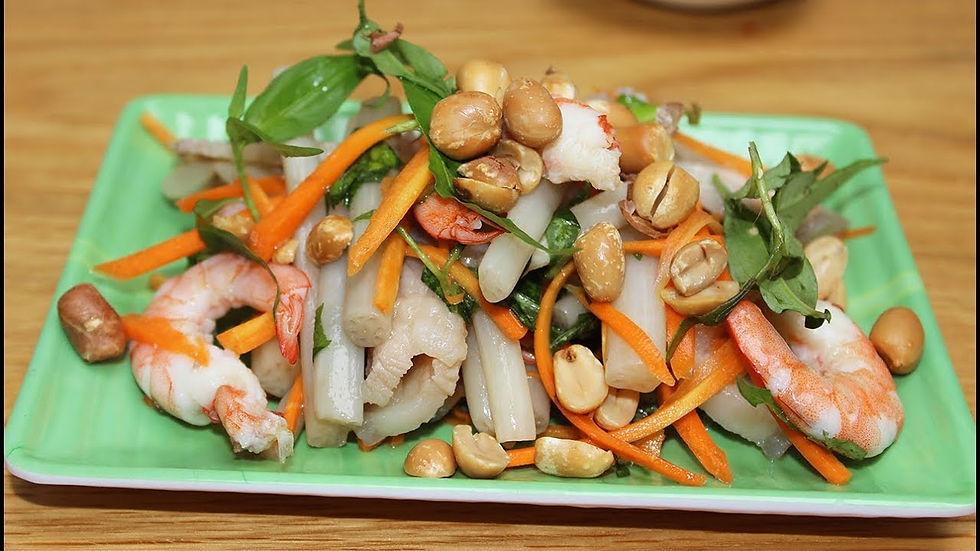
Typically used in salads, especially in combination with shrimp and pork. It’s crisp and mildly sweet.
Lotus Leaves (Lá sen)
Used as natural wrappers to steam rice (cơm hấp lá sen), giving the rice a fragrant, herbal aroma.
Lotus Stamens (Tua sen)
Tea Infusion: Dried stamens are used to scent green tea (trà sen), a delicacy in Vietnam. This process is labor-intensive and produces a highly prized aromatic tea.
For years beyond my awareness, Vietnamese people have used every single part of this multifaceted crop. There is honor in utilizing all parts of a plant, a necessary way of living when one has nothing. A country that was known to be of the third world, what happens when you find yourself in a streak of good fortune?
As you trace your finger on its map you’ll see that two rivers reach each end of its native land, allowing the perfect environment for rice to be cultivated at a mass rate. If you were to trace your finger over the map again, you would discover the lengthy, straight distance between what would resemble two rice basket cities, connected by a symbolic yoke.
Vietnam’s average age as of 2025 is 33 years old.
We have been blessed with acceptance in a foreign country with the promised opportunities that it boasts while simultaneously having a youthful population that does not know of war. So I do find us teetering our baskets, when I see our people turn a blind eye on food you’re not used to, or languages you don’t understand. We are struggling to find the balance of remembering who we are, and progressing towards who we want to become.
We had the optimal recipe for a successful mass immigration. There are few jobs that give two immigrant women the chance to sit together, holding hands, and share the details of their day. They converse intimately, often in imperfect language, discussing everything from challenging coworkers to the best fruits to try. In these moments, they support each other both emotionally and financially, forming a bond that goes beyond work and chances to see how the other person lives.
I believe pho is the ideal entry point for introducing others to our cuisine and culture. It’s clear, customizable, and fragrant—an approachable dish that still carries depth. I am not upset that it’s the first thing people yell at me when they find out I am Vietnamese. Of course, there are far more complex dishes that deserve the spotlight, and I trust they’ll get their time. I’ll also add that it's absolutely fair for us to call out a Vietnamese restaurant for overcharging or when fusion cuisine misses the mark—like when someone just tosses fish sauce into a dish and calls it Vietnamese-inspired.
What’s not okay is staying silent, buried in our phones, afraid to explore lesser-known foreign cuisines, and not trying to give them the same passage. Instead of being resourceful with new flavors and kitchen wisdom, we cut the stems early and run. We need to stop making ourselves smaller out of habit or fear. Is it really “authentic” if we’re just trying to please palates shaped by people we feel inferior to?
And frankly, it’s disheartening—and a little embarrassing—that much of the older Vietnamese generation supported Donald Trump. We come from a strong matriarchal culture, yet we chose this? Asian masculinity challenges white supremacy, but we’re too afraid to shake the ground we stand on for people who have been on the same footing as us.
The rice baskets are teetering again.
And I just want us to remember that we owe it to ourselves to use every part of our history to dictate how we move forward—even if we have other options. I am again, nothing but happy to see the heightened interest in Vietnamese cuisine, but considering where we come from, I don’t think we should taint our food with bland, unflavored racism and the taste of ignorance. We're not remembering how important it is to use all of the plant.
“No mud, no lotus”.
As the season’s change with prospective questions like, “Is this authentic?” we must be able to trace back, carry our roots with us, and let our past walk beside us.
I believe we’re in our night time slumber. And I hope as we gain traction and influence, we can understand that true authenticity is how adaptable we are both in food and in perspective.
Special thanks:

To Jordan for Venmoing me money while I was on vacation and not knowing that it would allow me to not have to pick up a shift a work so I was able to work on this blog!!!

Jennifer for buying me this notebook that has inspired me to write my
thoughts when I have time.

To Lina for creating this digital space where I don’t have to fight a deadline, or feel the need to conform to any criteria

To my dad for being a bad ass and fighting on the American side, getting shot while being on a parachute, evacuating during the Fall of Saigon, leaving his family because they did not want to go to America, and then having me and my sister as his favorite mistakes and raising us on his own. All while buying a house in National City and starting his own Landscaping business with my uncle Jose. Cheers to him navigating his first time going through life too.
Also so Soundcloud for having piano covers I can listen to while I work

Comments